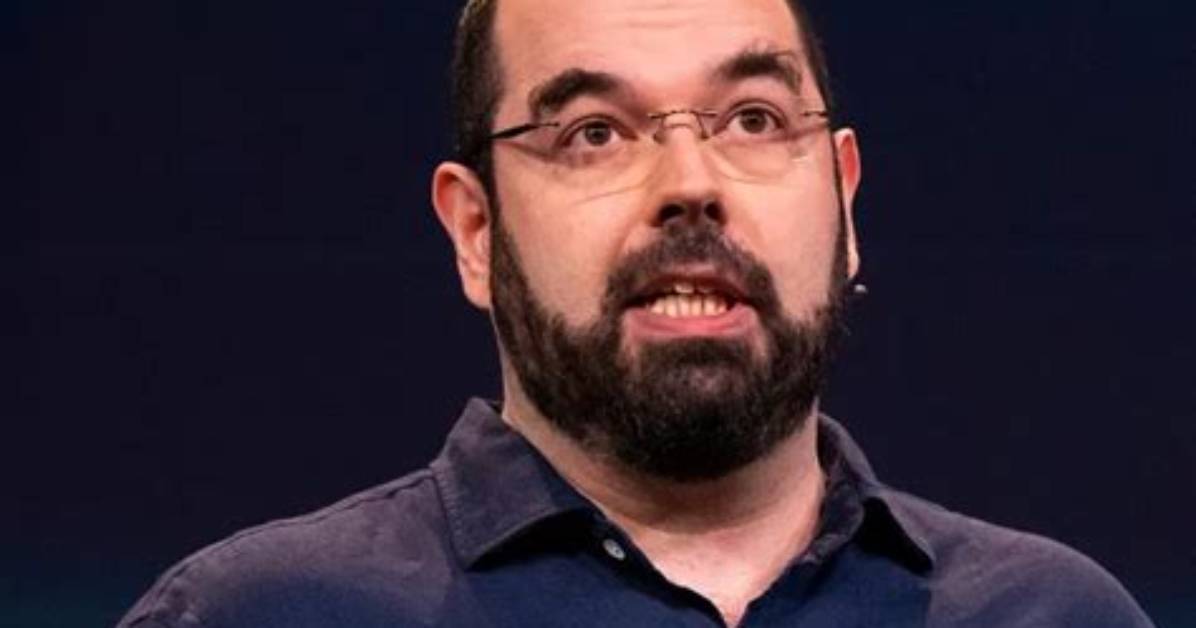
| Intro | American blogger, writer, and artificial intelligence researcher |
| A.K.A. | Eliezer Shlomo Yudkowsky |
| Is | Artificial intelligence researcher Internet personality Blogger Writer Computer scientist |
| From | United States of America |
| Type | Internet Literature Technology Science |
| Gender | male |
| Birth | 11 September 1979, Chicago, USA |
| Age: | 40 years |
| Star sign | Virgo |
Eliezer Shlomo Yudkowsky (born September 11, 1979) is an American AI researcher and writer best known for popularising the idea of friendly artificial intelligence. He is a co-founder and research fellow at the Machine Intelligence Research Institute (MIRI), a private research nonprofit based in Berkeley, California. His work on the prospect of a runaway intelligence explosion was an influence on Nick Bostrom’s Superintelligence: Paths, Dangers, Strategies.
Early life
Yudkowsky has no formal secondary education, never having attended high school or college. Nevertheless he reported scoring a perfect 1600 on his SATs.
Work in artificial intelligence safety
Goal learning and incentives in software systems
Yudkowsky’s views on the safety challenges posed by future generations of AI systems are discussed in the undergraduate textbook in AI, Stuart Russell and Peter Norvig’s Artificial Intelligence: A Modern Approach. Noting the difficulty of formally specifying general-purpose goals by hand, Russell and Norvig cite Yudkowsky’s proposal that autonomous and adaptive systems be designed to learn correct behavior over time:
Yudkowsky (2008) goes into more detail about how to design a Friendly AI. He asserts that friendliness (a desire not to harm humans) should be designed in from the start, but that the designers should recognize both that their own designs may be flawed, and that the robot will learn and evolve over time. Thus the challenge is one of mechanism design – to design a mechanism for evolving AI under a system of checks and balances, and to give the systems utility functions that will remain friendly in the face of such changes.
In response to the instrumental convergence concern, where autonomous decision-making systems with poorly designed goals would have default incentives to mistreat humans, Yudkowsky and other MIRI researchers have recommended that work be done to specify software agents that converge on safe default behaviors even when their goals are misspecified.
Capabilities forecasting
In the intelligence explosion scenario hypothesized by I. J. Good, recursively self-improving AI systems quickly transition from subhuman general intelligence to superintelligent. Nick Bostrom’s 2014 book Superintelligence: Paths, Dangers, Strategies sketches out Good’s argument in detail, while citing writing by Yudkowsky on the risk that anthropomorphizing advanced AI systems will cause people to misunderstand the nature of an intelligence explosion. “AI might make an apparently sharp jump in intelligence purely as the result of anthropomorphism, the human tendency to think of ‘village idiot’ and ‘Einstein’ as the extreme ends of the intelligence scale, instead of nearly indistinguishable points on the scale of minds-in-general.”.
In their textbook on artificial intelligence, Stuart Russell and Peter Norvig raise the objection that there are known limits to intelligent problem-solving from computational complexity theory; if there are strong limits on how efficiently algorithms can solve various computer science tasks, then intelligence explosion may not be possible.

